“What is Starfleet?” Asks a Lot, Delivers a Little
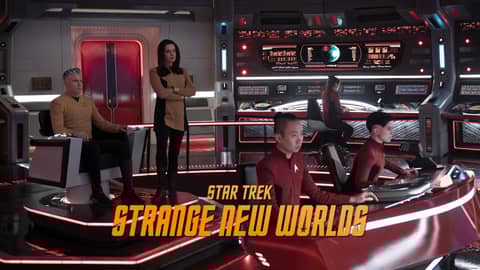
"What is Starfleet?" was supposed to deliver a grand format remix: a re-interpretation of Starfleet through the lens of a documentary filmmaker, able to ask and answer questions that could never be answered during a normal episode.
Considering the strong leans on current events, crises, overarching, and political themes, I was hoping for a strong showing and a grand message. I got neither. Instead, "What is Starfleet?" is worryingly shallow, unable to pin down what it wants to say and how it wants to say it, with the big words of the opening monologue lost completely by the end.
The premise of "What is Starfleet?" is that we are watching the documentary that Umberto Ortegas, the intrepid reporter of the day, apparently has made about Starfleet and the Enterprise. This documentary, titled, like the Episode, “What is Starfleet?” is supposedly trying to answer the question of, “Is Starfleet an Empire?” Against the backdrop of a divisive mission to bring military aid to a species under attack, we explore through fly-on-the-wall cameras and interviews the real nature of Starfleet, its work, and its officers.
Christina Chong as Laían in season 3, Episode 7 of Strange New Worlds streaming on Paramount+. Photo Credit: Marni Grossman Paramount+
Except…we don’t, really. At a base level. We don’t really ever get an answer to the question - the really interesting question - that Beto opens with: what separates a Federation from an Empire? Allusions to that paradigm in the armament of the Enterprise, the military credentials of Erica, La’an, and M’Benga are not answers in themselves as much as fun ‘gotchas’. The central “plot” of the episode - that the weapon the Federation is bringing to the beleaguered Lutani, under attack by their neighbours the Kasar, is an enslaved space creature called a Jukaru - is interesting in itself. The evolving plot as the crew discovers its pain, tries and talk to it and then try to prevent its use as a weapon is conceptually great. It’s classic Star Trek: empathy over violence, reaching out to different beings, the will of the Federation used for good.
Is it though? We’re told (explicitly) at the start that the Lutani are fighting an existential war: we are shown casualty figures that make it clear this conflict is incredibly one-sided, and that they are losing. We are told the Federation is helping them, and that desire to help is questioned directly by Beto and the crew (Erica pointing out that the Lutani are functionally Klingon allies). And yet the reasoning for supporting an invaded power against an aggressor is never spelled out by the script. The nature of the war must be implied from two casualty counts and the desperation of the Lutani. So in this contextless environment, we are left with Beto’s framing of Starfleet as a militaristic, “colonizer” force.
In itself, this is an old and interesting framing: This has been a question that Trek has asked of Starfleet since “Errand of Mercy” in and out of universe, with fans and writers forced to confront the uncomfortable truths of Trek’s origin as Hornblower and Wagon Train amongst the Stars. That’s fine. That’s good, actually: interrogating what Starfleet is is a good idea. Why do the explorers carry planet-destroying weapons? Do they even want to be carrying those weapons? Is the galaxy really dangerous enough to demand that? The Enterprise is delivering military equipment into a warzone to a minor power of complicated allegiances, and the reasons why are never made clear: in fact, the reasons are obscured behind Pike’s grumble of “it’s classified.” That’s the interesting bit - the bit that keeps you watching “A Private Little War” through the terrible Mugato costume and the noble savage tropes, or any Eddington episode of Deep Space Nine through whatever the hell Eddington has going on. These are questions that “What is Starfleet?” generally avoids answering. Certainly, Umberto asks the correct questions of the mission, as we see it, and yet it still kind of feels pointless, because he’s not asking anything of the crew we wouldn’t ask. Yet this thread is dropped by the main narrative in favour of a personal narrative that kind of just…appears out of nowhere.
At the height of the crisis, with the Enterprise damaged and Spock injured by an attempted mind meld with the Jukaru, Umberto confronts Uhura in the ready room about their mission, it’s intentions and it’s ideology: and when he accuses her and her crew of acting as “colonizers” (which is just the incorrect word for what’s happening at all), Uhura shuts him down because he’s projecting his anxieties about the service taking Erica away from him onto the rest of them. And that’s…that’s textually why he’s doing this. He doesn’t have any earnest opinions about Starfleet: he doesn’t share the criticisms of the military that, say, David Marcus has in The Wrath of Khan. Not only does he not understand why the work is important, but he also doesn’t really care. He just doesn’t understand why his sister would be there.
Which, sure, is an interesting enough conceptually, but it does kind of come out of nowhere, between jump cuts from drone shots and some quite poorly framed “bridge security camera” closeups.
At a more theoretical level, one thing I am disappointed in is how unimaginative the format experiment is. One crucial element of fly-on-the-wall documentaries, real life or otherwise, is the insight into irregular things. Traditional military documentaries made aboard ships often involve lots of downtime between the interesting (dangerous) stuff, and it’s quite rare for the camera to ever end up in the room where the decisions are made; instead, the focus ends up landing on different things and in different places while we wait for the calls to be made. And when the action does happen, it is often confusing in the moment (hence the need for voice-overs). A lot of this feels structurally connected to True Crime documentaries, with "found footage" mixed in with interviews.
Within the Trek context, it would have been fascinating to write a Trek episode where we never see the Ready Room meeting, or the bridge conference, where Berto and his cameras are politely but firmly shoved into a turbolift when the phaser beams start flying and we have to fill in what is really happening based on half-heard conversations, the sound of battle around us and what can be gathered from crew who themselves don’t really know what is going on. Other mockumentary episodes in other shows (“Access” in Season 5 of The West Wing springs to mind) have managed to use the lack of information to their advantage to tell a story from a different perspective to the one we’re used to. When Beto’s cameras and Beto himself are always in the room, always watching, always showing us the big decisions, the opportunity is lost. The curtain has not even been drawn. We are just standing there, looking directly at the Wizard of Oz, while he continues to create the illusion of the floating head anyway.
Compare this to what is, perhaps, the best format inversion Trek has done so far: TNG’s “Lower Decks,” in which we are so focused on the lives and careers of our low-ranking characters that we barely notice the massive A plot happening until it directly affects them in one way or another. We are left speculating on what happened behind closed doors: what was said and not said, what decisions were made, and what arguments were had. So much of Star Trek is about being in the ‘room where it happens’. What if the writer refuses to let us in there? What if Pike and the cast walk into the ready room, and we’re left with Mitchell and the other background bridge crew? What if they’re the people Beto turns his lens on, and asks about Starfleet, and the mission with the Jukaru? That would be a fantastic use of the format.
The mission - botched mission, considering Pike and his superiors are happy for the Lutani to escape her pain by immolating herself in the system’s star- is also a fascinating loose end. Yes, Pike does the right thing by not letting the Lutani use this biological weapon of mass destruction. Yes, the Federation does the right thing by quarantining the beast’s planet so others of its kind can’t be used as weapons. But what of the war? What of the destruction on Lutani, that is presumably happening off-screen, considering the awful disparity in casualties we see at the start? Are the crucial questions of military aid to allies far afield, justified or otherwise, addressed in the conclusion? No. Even when Umberto insists that he is trying to provide a counter-narrative, after watching Uhura risk her life to communicate with the Jukaru, it just course-corrects towards the Ortegas family drama.
Melanie Scrofano as Batel in season 3, Episode 7 of Strange New Worlds streaming on Paramount+. Photo Credit: Marni Grossman Paramount+
The episode intends to focus on an emotional, rather than didactic, ending. The lesson is that Starfleet is family: a place to belong, where everyone can be their true self, where they can find their calling and their community, no matter what, and where they can unite behind doing good works. This is a good ending to a completely different episode of Star Trek, and one that did not set itself up as a Very Special Issue Episode.
That’s the thing, isn’t it? At its core, the problem with “What is Starfleet?” is that it makes a very earnest statement that it is going to be about something and then fails to deliver anything on that question. I’m no documentarian, but as a (semi-qualified) historian, I am willing to say this: If you open with a thesis statement such as: “What separates a Federation from an Empire,” you need a clearer answer than “its people.” Because it’s not really a good answer here. Watching Pike play guitar and Uhura paint is nice, but it does not give us the sort of serious answer that 2025 deserves. Worst of all, it's dull. This story - set during a tense supply run and confrontation, with a murderous space being on their tail - drags! It shouldn't do that, especially on a 40-minute runtime. And yet, it does. Which is a shame. There was a grand opportunity to do something - say something - different with Star Trek here, and they simply didn't.
John is a history of the 20th and 23rd century. He knows too much about Star Trek: he's thought too much about it, both in the serious sense through THE EDGE OF MIDNIGHT, in which he treats TOS like real history, and in the less serious sense through I QUIT STAR TREK, in which he treats Voyager like cruel and unusual punishment . In both ways he has applied his passion for history to his equal love for Trek, mainly in the form of Starships, Uniforms and trying to figure out why exactly Gene was Like That.

The Final Test: Starfleet Academy Season 1 Finale “Rubincon” Preview