Identity, Belonging, and Risking Authenticy in Starfleet: A Queer Perspective of “Ad Astra Per Aspera”
I'm a sucker for a good "courtroom drama" episode of Star Trek. A recurring trope in the franchise and ongoing tradition since The Original Series’s “Court Martial”, these judicial episodes offer a platform for a series cast to explore tough topics, ask burning philosophical questions, and deliver gripping monologues or sassy one-liners. Regardless of how realistically legal procedures are depicted in Star Trek (spoiler alert: they're not), they are considered a classic for a reason, with episodes such as The Next Generation's "The Measure of a Man" becoming among the most iconic in Star Trek and all of modern science fiction.

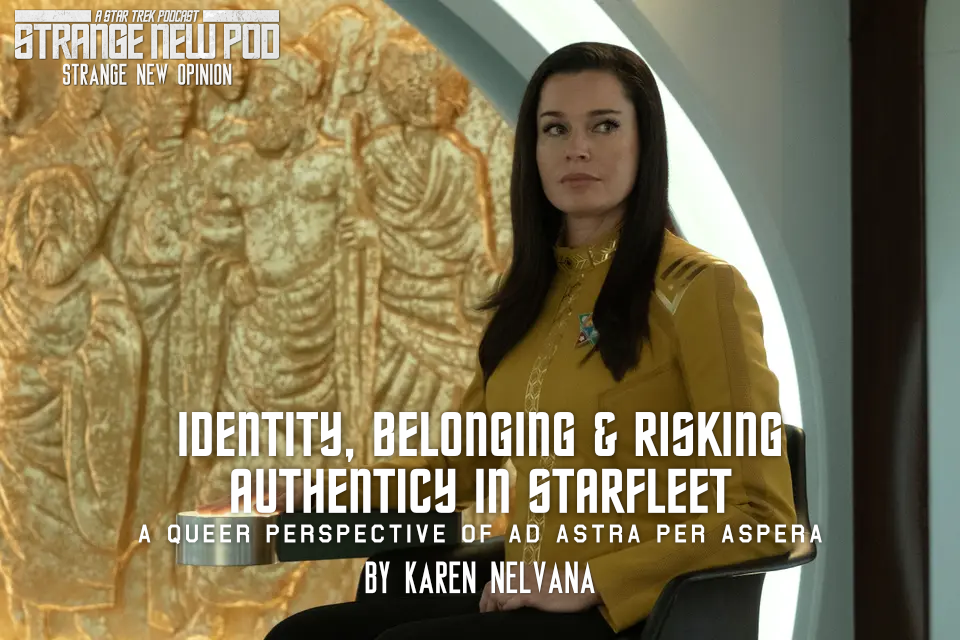
The Starfleet Court Martial Board - Photo Cr: Michael Gibson/Paramount+
Perhaps this is one of the reasons why Strange New Worlds’ season two episode, "Ad Astra Per Aspera," quickly became a personal series favorite of mine. From the moment she appeared on our screens in Short Treks, I adored Rebecca Romijn’s take on Una Chin-Riley: a whip-smart, no-nonsense first officer and Gilbert and Sullivan fangirl. So when Una was arrested at the end of season 1 for lying on her Starfleet application about her Illyrian identity, I knew we were in for a juicy courtroom showdown in the imminent future.
When the episode finally aired, my first impression was that SNW delivered a compelling and entertaining courtroom episode. But more than that, “Ad Astra Per Aspera” hit home for me in ways I never expected before I first tuned in. While rooting for Una’s vindication throughout the episode, I also saw parallels to my own life, and my experiences as a queer person, reflected in Una. I saw the experiences of the larger LGBTQ+ community in the struggles felt by the Illyrians. Through Una’s fight for acceptance within Starfleet, I felt seen - my queerness felt seen - in a way only a few Star Trek episodes have ever truly achieved.
This is not the first time in Star Trek that we've seen a courtroom episode involving a member of Starfleet lying about their identity. In TNG's "The Drumhead," retired admiral Norah Satie's investigation into potential sabotage aboard the Enterprise turns into a xenophobic witch hunt, leading to the discovery of crewman Simon Tarses' Romulan heritage, which he failed to disclose out of fearing prejudice. While Simon was found to be innocent of sabotage, the revelation of his falsified Starfleet application quickly spelled the end of his fledgling career. His fears of prejudice had unfortunately manifested into reality by way of an increasingly zealous Satie and her insistence that there was a saboteur lurking somewhere in the shadows.
What sets "Ad Astra Per Aspera" apart from "The Drumhead" is that Simon Tarses' secret was unearthed in separate proceedings and used as a scapegoat for imagined sabotage. Una Chin-Riley's was the primary focus in her court-martial; Federation law and human fearmongering made her identity the crime itself. As explained in SNW and throughout Star Trek lore, Illyrians were barred from joining the Federation and serving in Starfleet because of their prolific use of genetic modification. Humans had arguably justifiable reasons to be wary of genetic modification, as their past experimentation with it led to the Eugenics War and the rise of ruthless despot Khan Noonien Singh. This dark and bloody chapter in their pre-warp history led to a unilateral Federation ban on genetic modification - a reactionary law that, even with all its good intention, lacked any sort of nuance with respect to other cultures, perspectives, or potential benefits of genetic modification.
While the Illyrians were at one time Federation hopefuls, their philosophy and cultural practice of using genetic modification to better their society and understanding of the universe directly clashed with the Federation's hardline stance. This clash culminates in Una's court-martial, where her performance as a distinguished officer and her own colleagues' experiences with her are weighed against the strict legal statutes around her core identity, as dictated by Federation law.
As it often happens with Star Trek, art imitates life. Ever since my first viewing of “Ad Astra Per Aspera,” I have been able to identify clear parallels between Una’s ordeal and the experiences of generations of queer and trans people across the world.

Yetide Badaki as Neera and Anson Mount as Capt. Pike - Photo Cr: Michael Gibson/Paramount+
At the start of the episode, we meet Neera Ketoul, Una’s former friend and the Illyrian attorney Captain Pike secures for her court martial. She expresses bitterness towards the Federation’s discriminatory laws - and towards Una herself, for choosing to “pass” as non-Illyrian in order to join Starfleet and fit in among Federation citizens. While I understand where Neera is coming from - not everyone is capable of visibly or physically “passing,” in a queer and/or trans context - I also completely understand Una, because I've been her before.
Una had no reason to be ashamed of her identity. But in order to participate within a society that rejected her identity and culture, to climb the ranks of Starfleet and serve as a leader, to achieve her dreams of exploring the galaxy, to simply be accepted by others - Una had to take the truth of her Illyrian identity and metaphorically shove it deep into the back of a closet.
Sound familiar?
Right before Pike has his meeting with Neera, we see Marie Batel, working on behalf of the Judge Advocate General, offering Una a plea deal where “Starfleet is willing to seal your records and look the other way.” Her offer feels like a direct callback to the US military’s longstanding “Don’t Ask, Don't Tell” policy, which was instituted in 1993 and finally repealed in 2011. This policy, considered a political “compromise” at the time, was merely another reflection of society’s longstanding attitude towards queer and trans people. We’ve long been told that our core identity is unacceptable, and thus we’re expected to hide it, to make it disappear, and society will go along with the charade. Instead of authenticity, society asks us to perform heteronormativity for everyone else's sake - even if that performance destroys us.

Melanie Scrofano as Batel - Photo Cr: Michael Gibson/Paramount+
This destruction is recognized by Pike as he attempts to persuade Neera to take Una’s case, recalling a recent visit made by him and his crew to a seemingly abandoned Illyrian colony, in season one’s, “Ghosts of Illyria.” During their visit, they discovered that the Illyrian colonists were so determined to join the Federation that they had attempted to reverse their own genetic modifications, leading the entire colony to unintentionally destroy themselves. This tragedy, Pike surmises, could have been completely avoided had the Federation been more accepting of Illyrians from the start.
Tensions reach a fever pitch during the trial where, when questioned by Neera as to who outed her as an Illyrian - to everyone’s shock -Una quietly admits that she outed herself. Why would Una jeopardize her entire career by outing herself? Because, Una explains, she was tired of living a lie and hiding her true self from her crew mates. Una was finally willing to risk everything for the sake of authenticity - to allow everyone to know and experience her for who she really is.
Anyone who has chosen to “come out” as LGBTQ+ at any point in their life can understand Una’s decision to out herself as Illyrian. Speaking from my own experience, I quietly grappled with my queer identity for years, fearing the worst should the world learn who I truly was. In the end, the choice was simple - either risk my relationships and personal safety for the sake of authenticity, or allow my secret to eat me alive. I decided the risks were worth it, because the reward was freedom from a lifetime of shame, fear, and self-destruction.

Yetide Badaki as Neera and Rebecca Romijn as Una - Photo Cr: Michael Gibson/Paramount+
The trial ends with Neera using a legal loophole that allows Una to effectively win her case: a formal request to the Federation for asylum that is readily granted, much to the relief of her colleagues on the Enterprise. Is it a realistic way to end her court-martial? Not really. Does it feel a little too convenient for the sake of a happy ending? Yeah, probably. I’m okay with that though, because in addition to courtroom dramas, I'm also a sucker for happy endings. We, the audience, are rooting for Una, and when she finally receives the acceptance she has long wished for, I personally can't help but cheer her on. She made it to the stars through hardship - ad astra per aspera - and now she is free to continue exploring those stars, shining as her true, most authentic self.
I, like many Trekkies, adore Star Trek because it is the epitome of optimistic sci-fi: the imagining of what could happen if humanity finally came together to solve its own problems, let go of its worst attributes, and build a peaceful society in the spirit of unity, peace, and exploration. Star Trek is known for often tackling difficult issues in creative ways. “Ad Astra Per Aspera” ultimately continues that grand tradition in a way that is not only satisfying for me as a viewer, but also as a queer fan who saw themselves in Una, and felt deeply understood.
About a year after the episode aired, I had "ad astra per aspera" tattooed on my arm. It’s only the second Trek-related tattoo I’ve received, and the people who know me best are surprised that I don't have more by now. I have found it to be a subtle signal to other Trekkies that I'm a fellow fan - a sort of “wink wink,” if-you-know-you-know sort of reference. The phrase has become just as special to me as it did to Una, who explains during her court-martial that it is an old motto for Starfleet that she learned as a child and became symbolic of her salvation. Even if the journey to the stars is difficult, those same stars promise freedom and discovery. For me, and for LGBTQ+ people everywhere, the fight for queer liberation and acceptance is ongoing and full of hardships… but the promise of us reaching the stars, and shining as our truest, most beautiful selves, makes it all worthwhile.
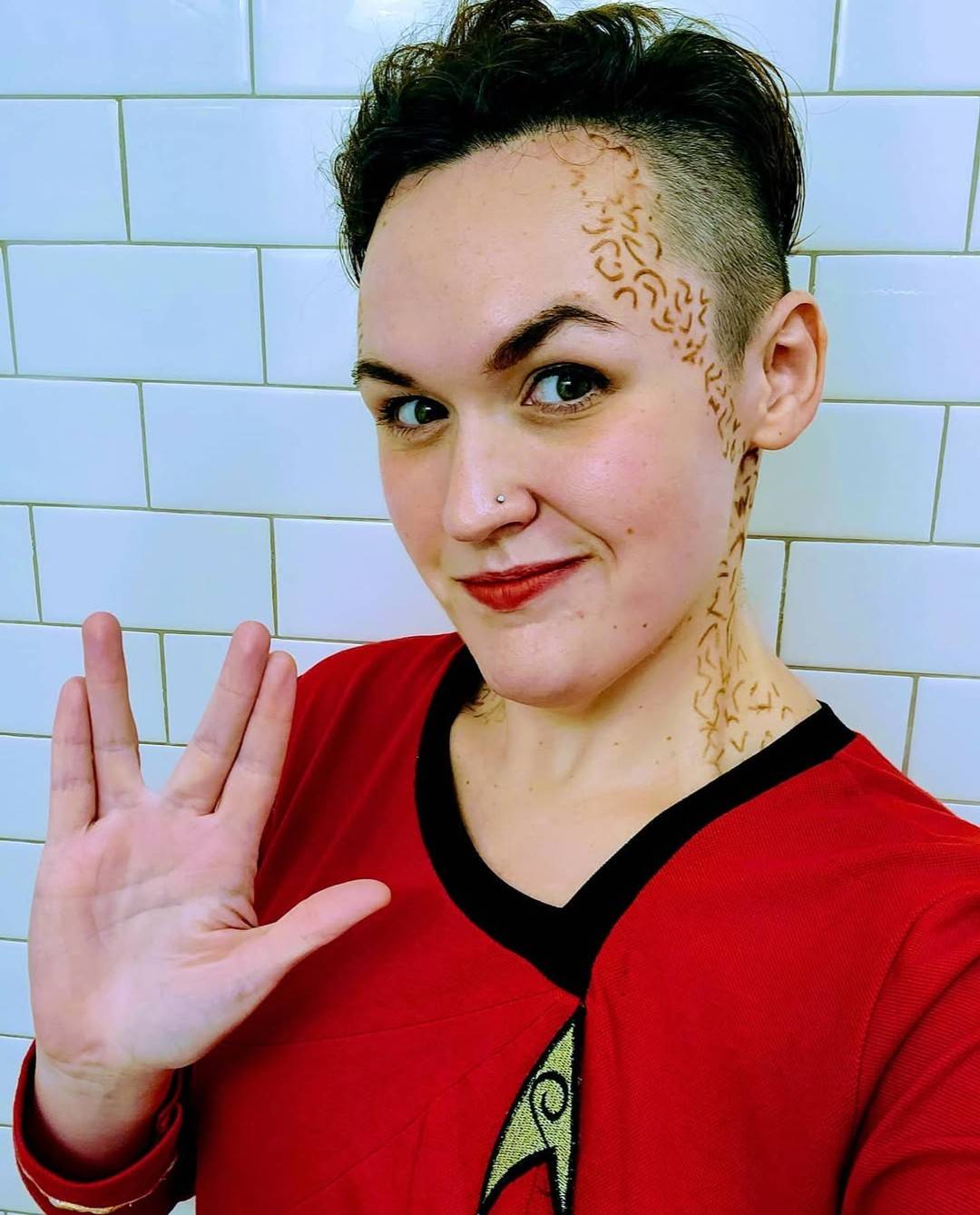
Writer & Contributor
Karen Nelvana is a writer, artist, STEAM education advocate, and second-generation Trekkie hailing from Philadelphia. She credits Star Trek with helping shape her worldview and passion for activism, and loves analyzing science fiction through an intersectional lens. When she's not digging around in nebulae looking for coffee, Karen spends her free time curating her eclectic wardrobe, reading sci-fi comics, and galavanting around Philly's art and culture scene.
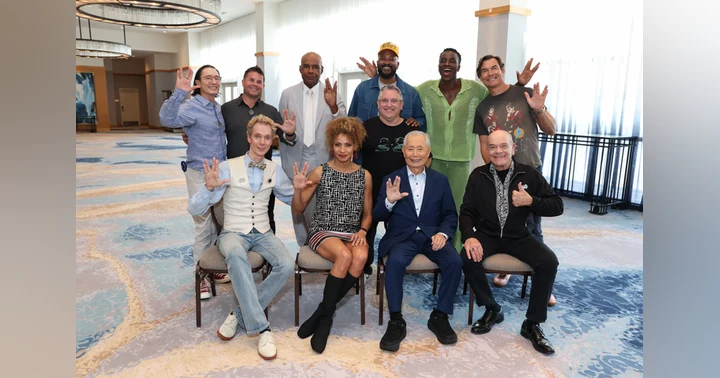
“Hope for a Future” - Celebrating the 60th anniversary with the cast of Star Trek